
Understanding Email Open Rates in Modern Campaigns
Email open rates still appear in every campaign report, but what they tell you has changed. Privacy features, image proxying, and automated opens mean email open rates no longer work as a clean measure of interest or engagement. You can still use them, but only if you understand their limits and read them in context.
This guide explains what email open rates mean today, why they became less reliable, and how you should use them in modern campaigns.
What an email open rate measures
To understand modern open rates, it helps to look at how email opens are tracked.
Email open rates measure the percentage of delivered emails that register an open. Most email platforms track this using a small invisible tracking pixel.
An open is recorded when:
- The tracking pixel loads
- Images are enabled in the email client
Why email open rates are less reliable than they used to be
A common question we hear is: are email open rates accurate anymore?
Apple Mail Privacy Protection (MPP)
Apple introduced Mail Privacy Protection in iOS 15. When enabled, Apple:
- Pre-loads email images automatically
- Loads the tracking pixel whether or not the user opens the email
- Time of open
- Location data
- Device-based behaviour
Gmail image proxying
Gmail uses image caching and proxying:
- Images load through Google’s servers
- Pixel loads can be delayed or batched
- “Real-time” opens become less accurate
Segmenting Apple Mail Users Affected by MPP
One practical way to reduce confusion in reporting is to separate Apple Mail users affected by Mail Privacy Protection.
A common approach is to create a segment such as:
- “Apple Mail (MPP likely)”
- Treat open rates as estimated, not factual
- Avoid using opens for automation triggers
- Rely more heavily on clicks and onsite behaviour
Segmentation does not fix open rate inflation, but it does prevent inflated data from distorting wider performance analysis.
How email open rates should be explained to clients
If we explain this to a client, the framing matters.
- Email open rates still have value, but only as a directional signal
- They do not prove interest, attention, or engagement
- Privacy features inflate opens, especially on Apple Mail
- Open rates should always sit alongside clicks, conversions, and revenue
What email open rates are still useful for
Despite their limits, email open rates still help in specific situations.
They work well for:
- Tracking trends over time
- Comparing campaign A vs campaign B
- Spotting sudden spikes or drops
- Identifying possible deliverability issues
- A/B testing subject lines within the same audience segment
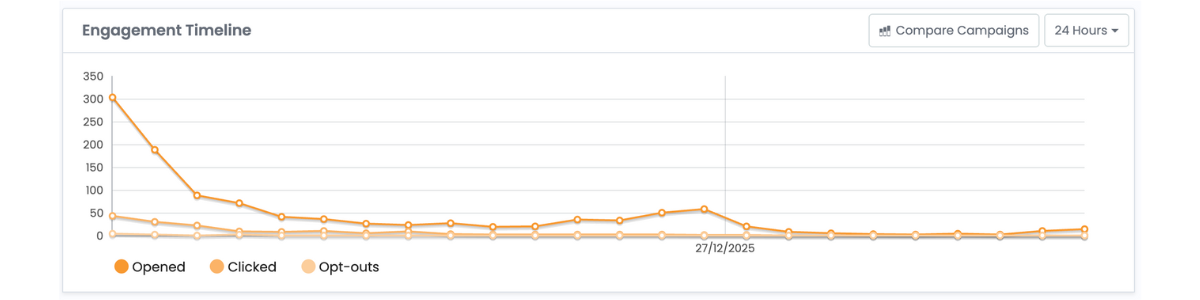
The engagement timeline below shows this in practice, making it easier to see trends, spikes, and drops in activity after a campaign is sent.
What email open rates are no longer good for
Open rates should not drive decisions that rely on individual behaviour or precise timing.
They perform poorly for:
- Tracking individual user engagement
- Send-time optimisation based only on opens
- Location-based insights
- Triggering automations based purely on opens
How to Adapt Automations Away from Open-Based Triggers
Open-triggered automations now carry real risk. Privacy features like Apple Mail Privacy Protection can trigger opens automatically, even when no human action has taken place.
This can cause:
- Premature follow-ups
- Incorrect lead scoring
- Broken nurture flows
Replace open-based triggers with:
- Clicks on specific links
- Product views
- Add-to-cart events
- Purchases
- Onsite actions or events
Open-based triggers are not wrong; they are just unreliable. Using them as a primary decision point now introduces noise into automation logic.
Factors that still influence email open rates
Even with privacy changes, some fundamentals still matter.
List quality
- Permission-based lists outperform purchased lists by a large margin
- Old or disengaged contacts drag averages down
- Regular list cleaning improves all metrics, not just opens
Subject line relevance
- Clear subject lines outperform clever ones
- Personalisation works when it reflects real context
- Overuse of urgency or gimmicks reduces trust over time
- “Last chance”
- “Don’t miss out”
Sender name and trust
- Recognisable sender names matter
- Sudden sender changes hurt consistency
- Stable sender identity improves inbox confidence
Inbox placement and authentication
Inbox placement affects opens more than wording.
Authentication matters:
- SPF
- DKIM
- DMARC
Metrics that matter more than email open rates
If open rates no longer show true engagement, the next question becomes what to use instead of open rates.
If you want to understand performance, these metrics carry more weight:
- Click-through rate (CTR)
- Click-to-open rate (CTOR)
- Conversion rate
- Revenue per email (for ecommerce)
- Unsubscribe rate
- Spam complaint rate
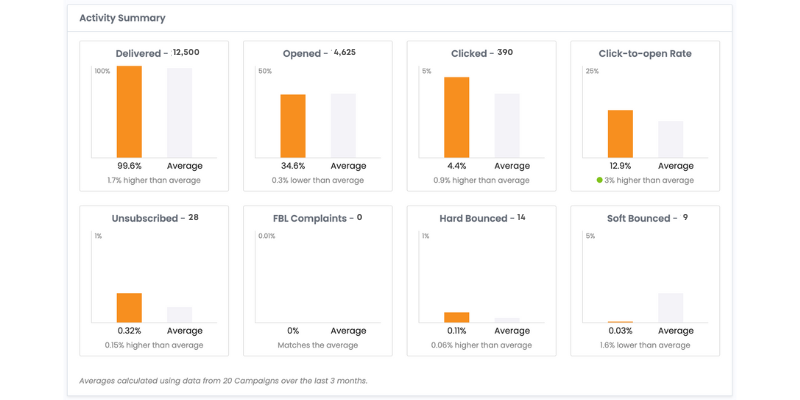
The example below shows how this looks in practice inside iocea mailer’s campaign overview, where open rates sit alongside delivery, clicks, and engagement trends.
How to Report Email Performance in 2026
When reporting email performance in 2026, the goal is clarity, not volume. Clients do not need every metric an email platform can surface. They need a structure that shows cause, effect, and outcome.
A simple, client-ready reporting flow looks like this:
- Deliverability
Are emails landing in inboxes or being blocked, bounced, or filtered? - Clicks
Are recipients taking meaningful action inside the email? - Conversions
Do clicks lead to sign-ups, enquiries, or purchases? - Revenue
What commercial value did the campaign generate? - List health
Is the audience growing, disengaging, or churning?
Email open rates can still be mentioned, but only as a trendline, not a performance headline. We use opens to answer questions like “Is something materially changing over time?” not “Did this campaign succeed?”
How we recommend using open rates at iocea
We treat email open rates as:
- Indicative
- Comparative
- Best used alongside other metrics
- A/B testing results
- Click behaviour
- Conversion tracking
- Automation triggers based on actions, not opens
This avoids decisions based on inflated or automated signals.
Frequently Asked Questions
What is an email open rate?
The percentage of delivered emails that register an open, usually tracked when a small invisible image loads.
Are email open rates still accurate?
They are less accurate than they used to be due to privacy features like Apple Mail Privacy Protection and image caching. They work best as directional data, not exact measurement.
Why do my open rates look higher than before?
Some email clients trigger tracking pixels automatically, even if the email is not actively opened by the user.
Can open rates still measure performance?
Yes, but only in context. They help compare campaigns, spot trends, and test subject lines within the same audience.
What affects email open rates the most?
List quality, subject line relevance, sender recognition, inbox placement, and consistency.
Should automations still trigger based on opens?
Open-based triggers are increasingly unreliable. Clicks, page visits, or purchases provide more dependable signals.